
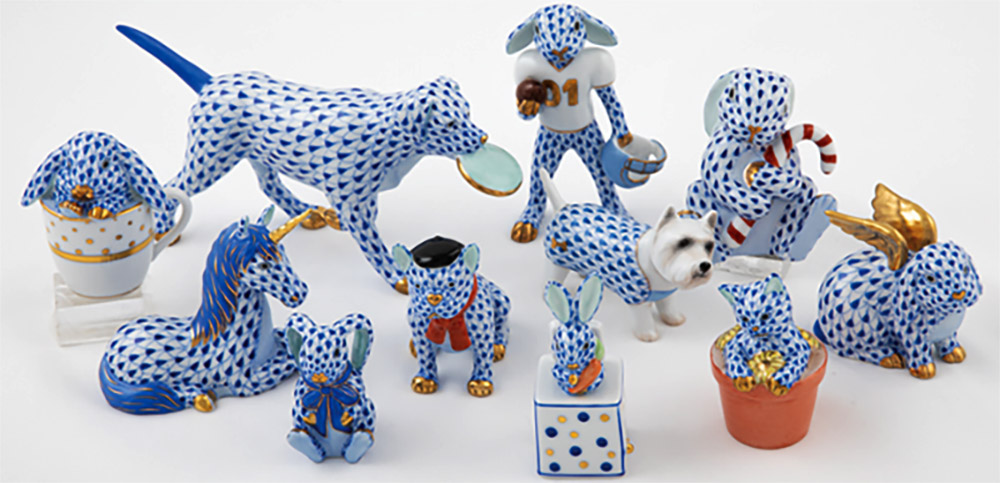
Herend figurines

Herend Porcelain: Decoding the Elegance and Enduring Collectible Value of Hungarian Hand-Painted Artistry

Herend: Three centuries of Hungarian mastery distilled into porcelain. Celebrating the iconic hand-painted Fishnet animals, Rothschild birds, and rare limited editions that define luxury collecting today.

There are collectibles, and then there is Herend.

If you’ve ever held a small, perfectly balanced Herend bunny or examined a delicate bonbonnière, you know exactly what I mean. It’s not just the weight of the porcelain or the mesmerizing perfection of the hand-painted fishnet pattern; it’s the sense that you are holding a piece of history, an heirloom meticulously crafted for royalty centuries ago, yet still vibrant and alive today.

When most people think of fine porcelain, they might conjure up images of Meissen or Sèvres—the grand European houses. But Herend, nestled quietly in the heart of Hungary, holds a unique place. It is a world of playful artistry, where elegance meets whimsy, and where the most valuable items are often not the stiff, formal court ladies but the charming, hand-painted animals.

The collectible market for luxury porcelain is in a fascinating place right now (2024–2025). Mass-market figures are losing steam, but pieces that demonstrate true, labor-intensive craftsmanship—like Herend—are retaining or even increasing their value. This deep dive is for those of us who appreciate the delicate stroke of a human artist’s brush, the history behind the famous Fishnet pattern, and the complexity of dating and valuing a collection of Herend figurines.

Let’s begin the journey into Hungary’s “white gold.”

Part I: The Hungarian Crown Jewel – History, Royal Patronage, and Technical Foundation

The story of the Herend Porcelain Manufactory is one of resilience, genius, and a powerful ascent from a small provincial workshop to a global supplier of royal and aristocratic houses.

1. The Founders: Stingl and the Genius of Mór Fischer (1826–1872)

The factory was established by Vince Stingl in the village of Herend, Hungary, in 1826. However, its true genesis as a porcelain powerhouse occurred in 1839 when it was acquired by Mór Fischer. Fischer was a man of immense business acumen and artistic vision. At the time, Hungarian porcelain struggled to compete with its Austrian and German rivals, such as Vienna and Meissen. Fischer set out not just to compete, but to surpass them, focusing on the quality of the raw materials and the artistry of the decorations.

Under Fischer’s direction, Herend became renowned for two things: flawless hard-paste porcelain (often referred to today as the signature “white gold”) and its remarkable ability to create flawless replacements for damaged Meissen, Sèvres, and Chinese Export porcelain owned by Europe’s wealthiest families. This gave Herend a unique reputation for both originality and historical accuracy.

2. The Defining Moment: The Great Exhibition of 1851

Herend’s big break—the moment that cemented its international fame and enduring status—came at the Great Exhibition in London in 1851. Fischer showcased Herend’s finest work, and it captivated the attention of Queen Victoria herself.

The Queen was particularly drawn to a pattern featuring delicate, multi-colored butterflies and floral motifs against a crisp white ground. This specific design, which had its roots in the Japanese Kakiemon style, was immediately purchased by the Queen for Windsor Castle. In honor of this prestigious patronage, the pattern was officially renamed the Queen Victoria Pattern (VBO – Victoria avec Bord en Or). This single event transformed Herend from a regional factory into an international luxury brand, ensuring its immediate royal acclaim.

Subsequent exhibitions in New York (1853) and Paris (1855) brought further accolades and royal orders, establishing Herend as the official Supplier to the Imperial and Royal Court of the Austro-Hungarian Monarchy by Emperor Francis Joseph I in 1872.

3. The Foundation of Craftsmanship: Herend’s Hard-Paste Porcelain

The quality of any porcelain is determined by its paste and firing process. Herend’s “white gold” is a complex hard-paste formula that requires two separate high-temperature firings (biscuit and glaze) and subsequent firings for each color applied.

  • Hand-Modeling: Every single Herend figurine begins with a meticulous hand-molding process. The pieces are cast, but the smaller, intricate parts (like a rabbit’s ear, a bird’s beak, or a decorative rose on a box) are individually modeled and applied by hand, an astonishing technique that ensures no two pieces are exactly alike.
  • The Painter’s Legacy: The paintwork is done by master artisans. Herend requires its painters to undergo years of rigorous training—often up to ten years—to master the precise, vibrant brushwork and complex color palettes. This intense dedication to manual artistry is the primary reason why Herend pieces retain high value, as they stand in sharp contrast to mass-produced, decal-transferred modern pieces.

Part II: Decoding the Artistry – The Iconography and the Fishnet Phenomenon

While Herend produces magnificent dinnerware, its Herend figurines and ornamental pieces are the true heart of the collectible market. They are broadly defined by their famous patterns.

1. The Origin of the Iconic Fishnet Pattern (VH)

For modern collectors, the most recognizable and widely sought-after pattern is the Fishnet pattern, or Vieux Herend (VH) as it is formally known.

The Legend: The story behind the fishnet design is famously rooted in whimsy. According to Herend lore, an artisan at the factory, seeking inspiration for a decoration, was looking at a cat playing in the studio. To stop the cat from running off, the artisan sketched a fishnet pattern over its body. The resulting design was so charming that it was adopted for a whole range of animal figures.

  • Colors and Value: The classic Herend Fishnet color is deep blue (VHB). However, the pattern is produced today in dozens of colors, including rust orange, lime green, black, lavender, and even a multi-colored rainbow version. Generally, the classic blue and the striking rust orange variants are the most widely collected and maintain steady values. Rarer colors or limited edition colorways, such as certain purples or pinks, can sometimes command a premium due to scarcity.

2. The Zoo of Herend Figurines: Animals and Whimsy

The vast majority of Herend figurines are animals, and certain pieces have become collector staples. When searching for valuation, collectors frequently use keywords like Herend bunny rabbit value, Herend elephant figurine, and Herend cat fishnet.

  • The Rabbit Collection: The Herend bunny rabbit is arguably the most prolific and popular figure. They appear in countless poses: sitting, lounging, celebrating (with gifts or flowers), or playing sports (the famous Tennis Bunny). Their small size and charming nature make them ideal entry-level collectibles (starting around $100–$250 retail), but rare or retired poses can easily exceed $500.
  • The Ocean Life: Aquatic animals like dolphins, seahorses, and fish are prized for their graceful modeling and the way the Herend fishnet pattern naturally flows over their curved bodies.
  • The Wild Kingdom: Herend has modeled a massive range of wild animals, often in majestic or complex forms—from elephants (trunks up for luck, often commanding prices from $400–$1,200) to bears, lions, and exotic birds. The rarest pieces are often large-scale, intricate models like the Mountain Lion or the Double Giraffes, which are frequently released as high-value, strictly limited edition sculptures.

3. The Majestic Patterns: Tableware on Figurative Forms

The famous dinnerware patterns often find their way onto smaller, ornamental pieces like trinket boxes, vases, and bonbonnières, which are essential parts of a figurine collection.

  • Rothschild Bird (RO): This pattern, featuring small birds (often a pair on a branch) and scattered insects or butterflies, is famed for its 12 variations. Its delicate naturalism makes it highly sought after for decorative pieces and specialty eggs.
  • Chinese Bouquet (Apponyi): Originally a rush order for Count Albert Apponyi in 1867, this pattern is a simplified floral motif (often a single bouquet repeated). It is found in many vibrant colors (rust, green, blue) and is a sophisticated choice for Herend’s bonbonnières and jewelry boxes.
  • Queen Victoria (VBO): Reserved for the most opulent pieces, the VBO pattern’s multi-colored butterflies and floral sprays on ornamental pieces scream luxury and history.

Part III: Decoding the Herend Markings and Valuation

To truly understand your Herend figurine value, you must learn to read the backstamp and the complex coding system used by the factory. This systematic approach is key to authenticating and dating your porcelain.

1. The Backstamp and Dating

The standard Herend mark features the blue printed Herend shield and the text “Herend Hungary Handpainted.” The primary dating clues are:

2. The Complex Product Code: 00000-0-00 XXX

Every piece of Herend porcelain has a detailed, unique alphanumeric code on its base. Learning this system is vital for collectors using keywords like Herend item numbers or Herend pattern codes.

If your figure has a unique three-digit number painted on the base (e.g., 14/25), this indicates a strict limited edition number, immediately elevating its price.

3. The Artist Signature

Herend pieces are hand-painted by master artisans, who often sign their work with their initials or unique mark. Figurines signed by highly reputed or deceased artists may command a modest premium, as this adds a layer of personal provenance and artistry. Always search for the artist’s name (e.g., Herend figure artist signed) when documenting your collection.

Part IV: Market Analysis and Rarity (2024–2025 Trends)

The luxury collectibles market has stabilized recently, which is good news for Herend. Unlike volatile pop culture figures, the value of Herend is tied to intrinsic factors: labor, prestige, and scarcity.

1. Where the Value Lies Today

  • Scarcity and Scale: The highest prices are consistently achieved by pieces that are either very large, contain multiple figures, or were produced in very low limited edition numbers (usually under 250). Large animal sculptures, such as the Csikós on Horseback (a massive Hungarian herdsman on horseback), or multi-figure animal groups can sell for $2,500 to over $7,000.
  • The Bunny Rabbit Index: The ubiquitous Herend bunny rabbit remains the market anchor. New collectors often start here, ensuring constant demand. While common poses sell for fair prices, the rarer variations (e.g., the Watering Can Bunny or Reindeer Rabbit) or older, retired molds hold their value best, particularly if they are mint and boxed.
  • Condition is Non-Negotiable: A chip or repair on a collectible Herend piece is catastrophic to its financial value. Unlike furniture or paintings, which can be repaired, the fine hand-painted surface makes flawless condition mandatory for investment-grade valuation. Collectors demand mint condition, preferably with original packaging and documentation.

2. Current Hot Collectible Categories

3. Avoiding Fakes and Look-Alikes

Due to the value of Herend, collectors often search Herend porcelain fakes or Herend vs Herend style. The most common imitations use decals instead of hand-painting, lack the precision of the gold accents, or carry highly suspect markings.

  • The Gold Accent Test: Genuine Herend uses hand-applied, burnished 24K gold accents (not just gold paint) around the borders, bases, and often on the animal’s features (like the tusks of an elephant or the collar of a dog).
  • The White Gold Test: The body of the porcelain should be bright white, fine, and translucent, not grey or dull.
  • The Mark Test: Fakes rarely nail the complexity of the Herend coding system, especially the combination of the printed shield, the incised model number, and the hand-painted pattern code. When in doubt, always consult an expert specializing in Hungarian porcelain.

Part V: The Emotional Investment – Collecting Herend in the Modern Age

As we move deeper into the 21st century, the appeal of Herend has only grown stronger. In a world saturated with digital ephemera and disposable goods, there is a profound satisfaction in collecting something that requires hundreds of hours of human labor, something that embodies a tradition dating back to the Austro-Hungarian Empire.

Collecting Herend is a highly personal endeavor. Some collectors strive for completion—acquiring every bunny in the Fishnet pattern, for instance. Others focus on one specific theme, such as exotic birds, human carnival figures, or pieces with the rare Indian Basket pattern.

The real enduring Herend figurine value isn’t measured in auction dollars, but in the generational legacy it creates. These are pieces meant to be displayed, handled (carefully!), and passed down. They represent a tangible link to European artistry and a commitment to elegance that transcends fleeting trends.

If you’re embarking on your Herend collecting journey today, start with the piece that makes you smile—perhaps a blue fishnet kitten or a box with the beautiful Rothschild Bird pattern—and let that piece be the foundation of a legacy of beauty that will charm collectors for centuries to come. You are not just buying porcelain; you are preserving a craft. You are becoming a custodian of Hungary’s “white gold.”